OSP restoration
Long spans need the dynamic range stated at the pulse width the crew will actually use. Note temperature range if the handheld stays in a truck.
FIBER TEST PROCUREMENT
A fiber OTDR price is comparable after the wavelength set, dynamic range, and dead-zone conditions are written as one configuration. LinkScope Sourcing 11 is an independent sourcing partner that collects that brief and asks factories to quote the same handheld, accessories, and US destination.
Prepare the product family, fiber mode, connector, quantity in pieces or kits, and the evidence you want tied to the exact model. A brochure range such as 1310/1550 nm does not by itself state the pulse width used for the event dead zone.
Request Factory Quotes Review inquiry options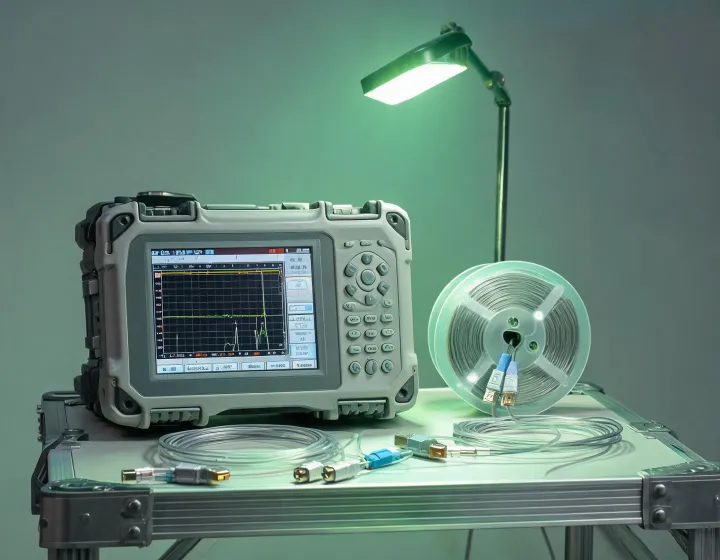
Ask each proposed factory to name the manufacturer, model, and firmware used for its answer. ITU-T optical-fibre recommendations can frame wavelength questions. They do not certify the instrument on the quotation.
| Check | What to request | Why it changes the quote |
|---|---|---|
| Wavelength | 1310 nm and 1550 nm, or 1625 nm, or 850/1300 nm, as required | A missing wavelength is a different meter, not a cheaper line |
| Dynamic range | dB figure and the pulse width used to publish it | A larger pulse can inflate range and hide nearby events |
| Dead zones | Event dead zone and attenuation dead zone in meters, with pulse width | The nearest connector can sit inside the dead zone |
| Fiber and connector | Single-mode or multimode, FC, SC, or LC, and launch-fiber length | Adapter kits and a 150 m or 500 m launch reel change the delivered scope |
| Calibration | Current record tied to the serial number, not a family statement | Measurement accuracy and calibration traceability stay with that unit |
Read the procurement brief for the full field list, then send the same list through the RFQ.
Long spans need the dynamic range stated at the pulse width the crew will actually use. Note temperature range if the handheld stays in a truck.
Splitter loss and a short drop can demand a short pulse plus a launch fiber. Screen readability outdoors is a separate line from the optical module.
Short links and dense connectors make dead zone more important than maximum distance. Pair the meter question with insertion-loss test sets when patch cords are too short to trace.
Confirm fiber mode before locking 1310/1550 nm versus 850/1300 nm. A multimode plant and a single-mode meter are not interchangeable quotes.
Request the current datasheet page that names the model, wavelength, pulse width, and averaging time. A catalog sentence without those conditions is not the same evidence.
Event dead zone is a distance, often under a few meters at a short pulse and longer at a wide pulse. Ask for both dead-zone numbers and the launch-fiber plan.
Treat condition, remaining calibration interval, battery, and software license as separate lines. Do not fold them into one headline price until each supplier states them.
Name the US receiving site, quantity, and the week you need the instruments available for incoming inspection. That timing is a request, not a factory commitment.
Include wavelength, dead zone, quantity, destination, and the evidence list. Optional budget needs a currency and a per-instrument or whole-order basis. Supplier preference is a buyer note, not a rating.
QUALIFIED BUSINESS BUYERS
Compare quotations from up to 3 factories after the OTDR configuration is written down.
Eligibility applies to qualified business buyers and is confirmed after we review your product, quantity, destination, and sourcing requirements.